Tag: Colloquium
-
PICS Colloquium: “Exploiting time-domain parallelism to accelerate neural network training and PDE constrained optimization” with Eric Cyr
On Wednesday, April 24th at 10 AM EST, PICS will host a colloquium with Eric Cyr, Principal Member of the Technical Staff at the Computer Science Research Institute at Sandia […]
-

PICS Colloquium: “Representations Learnt from Synthetic Volumes Enable Training-free Medical Image Analysis” with Neel Dey
Speaker: Neel Dey, Postdoctoral Associate in the Massachusetts Institute of Technology Computer Science and Artificial Intelligence Laboratory Abstract: Current medical image analysis projects involve months to years of data annotation […]
-
PICS Colloquium: “Representations Learnt from Synthetic Volumes Enable Training-free Medical Image Analysis” with Neel Dey
On Friday, April 26th at 2 PM EST, PICS will host a colloquium with Neel Dey, Postdoctoral Associate in the Massachusetts Institute of Technology Computer Science and Artificial Intelligence Laboratory. […]
-
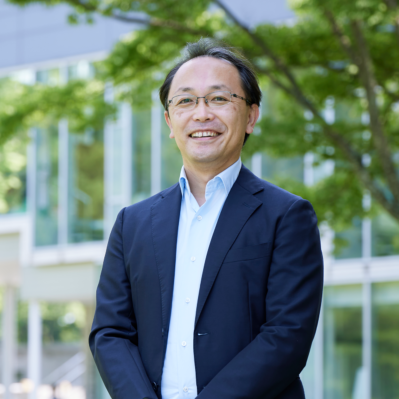
PICS Colloquium: “Physics-compatible kinetic-energy and entropy preserving (KEEP) scheme for high-fidelity simulation of compressible turbulence” with Soshi Kawai
On Friday, April 19th at 2 PM EST, PICS will host a colloquium with Soshi Kawai, Professor of Aerospace Engineering at Tohoku University. This colloquium will be held in-person in […]
-

PICS Colloquium: “Modeling Lone Pair Dynamics in Materials” with Richard Remsing
On Friday, April 12th at 2 PM EST, PICS will host a colloquium with Richard Remsing, Assistant Professor of Chemistry and Chemical Biology at Rutgers University. This colloquium will be […]
-
PICS Colloquium: “Modeling Lone Pair Dynamics in Materials” with Richard Remsing
Title: Modeling Lone Pair Dynamics in Materials Speaker: Richard Remsing, Assistant Professor of Chemistry and Chemical Biology at Rutgers University Abstract: Materials properties are governed by the structure and dynamics of […]
-
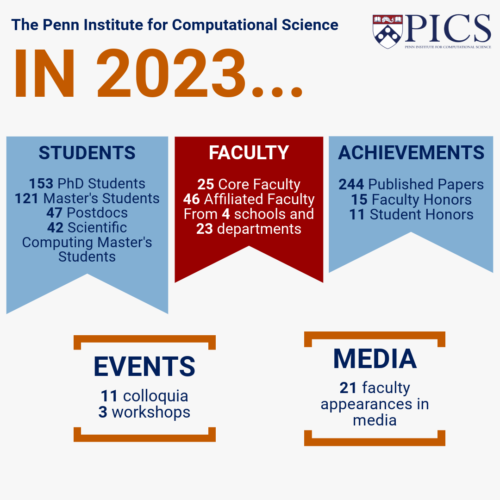
PICS Annual Report 2023: In Numbers
Over the past year, PICS faculty and researchers have published 244 papers, received a total of 26 faculty and student honors, and has offered plenty of events such as the […]
-
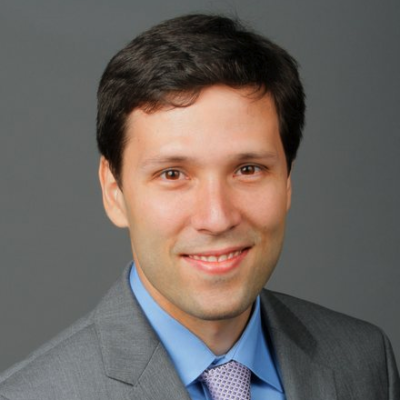
PICS Colloquium: “Genetic testing and adverse selection” with Eduardo Azevedo
Title: Genetic testing and adverse selection Speaker: Eduardo Azevedo, Professor of Business Economics and Public Policy at Wharton, John M. Bendheim Professor, Thomas L. Bendheim Professor Abstract: Technology is dramatically […]
-
PICS Colloquium: “Genetic testing and adverse selection” with Eduardo Azevedo
On Friday, February 23rd at 2 PM EST, PICS will host a colloquium with Eduardo Azevedo, Professor of Business Economics and Public Policy at Wharton, John M. Bendheim Professor, Thomas […]
-
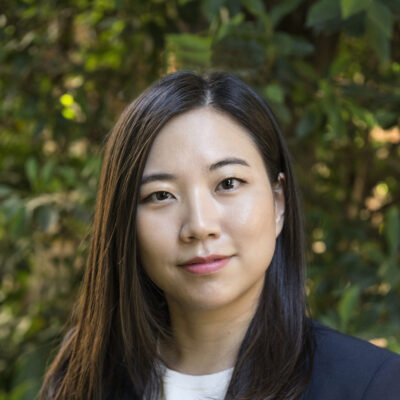
PICS Colloquium: “Wall-models of turbulent flows via scientific multi-agent reinforcement learning” with Jane Bae
On Friday, February 9th at 2 PM EST, PICS will host a colloquium with Jane Bae, Assistant Professor of Aerospace at Caltech. This colloquium will be held in-person in PICS […]